Corsair Cove Skull Rock Island — Full Game Home
Limbic's First Island Showcase: tropical skull cliffs, rough seas, and capital-scale vertical building.
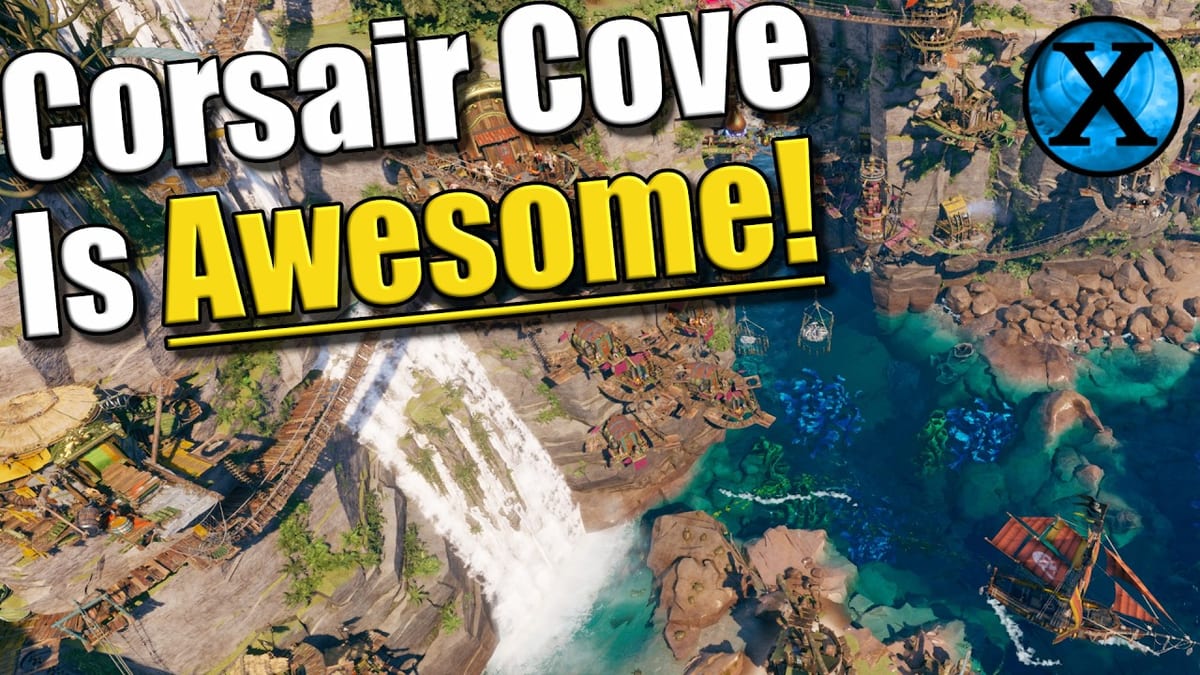
Skull Rock Island is Corsair Cove’s most marketed full-game home island — a tropical landmass dominated by a giant pirate skull carved into the skyline, waterfall greenery, and cliff bands that force vertical city-building instead of flat sprawl. Limbic Entertainment’s First Island Showcase trailer (July 2026) confirms Skull Rock as a launch-ready capital option distinct from the demo’s similarly shaped tutorial island. This guide explains terrain bands, hazards, salvage loops, and how Skull Rock connects to world-map exploration without duplicating the demo island walkthrough.
Island identity
Visual landmark. Skull Rock sells the pirate fantasy immediately: eye-socket alcoves become building pockets, jawline beaches host pier anchors, and upper cranium ridges offer gun tower sightlines over rough seas.
Dual tone. Press coverage stresses paradise aesthetics hiding danger — shipwrecks ring the island, sharks patrol nearby waters, and Crown interest escalates as your notoriety grows. Beautiful cliffs do not mean safe logistics.
Name overlap. Demo players already know “Skull Rock” as a nearby sea waypoint while living on a skull-shaped home island. Full release UI distinguishes home islands from exploration nodes, but wiki readers should note both uses when searching guides.
Elevation bands and building strategy
Skull Rock rewards the same vertical playbook as the demo, scaled for retail colonies:
Lower beaches and shallows. Pier foundations, fishing huts, loot piles, and repair queues belong here. Amara-style story bombardments in the demo teach that pier chokepoints need tower coverage — expect similar defensive vectors on Skull Rock’s full layout with additional shallow slots.
Mid-cliffs. Stack sawmills, warehouses, galleys, taverns, and moonshine stills on overhangs linked by ramps and rope bridges. Mid elevation balances drifter travel between upper quarries and lower piers — ideal for yellow-route efficiency if paths stay short.
Upper ridges. Housing tents, quarries, stone cutters, and long-range gun towers. Height advantage matters for covering multiple pier approaches on a large skull landmass. Upper camps also suit satellite industry when camp range circles cannot reach distant deposits from one mega-base.
Read vertical building for bridge capacity and zipline placement before you commit timber to the wrong ledge.
Resources and salvage
Trailer and press beats highlight shipwreck salvage around Skull Rock — planks, fittings, and story loot washing ashore or embedded in reefs. Treat wrecks like the demo’s opening hull: early industry fuel before sawmills saturate warehouses.
Expect familiar deposit types at retail scale:
| Resource | Typical band | Notes |
|---|---|---|
| Hardwood | Mid-island fertile patches | Woodcutter lines feeding sawmills |
| Stone | Upper quarry markers | Gun towers and cut stone chains |
| Fish | Coastal shallows | Galley inputs before grain imports |
| Cassava / fiber | Fertile soil pockets | Crew food and textile precursors |
| Salvage | Reefs and wreck fields | Burst planks early, taper as industry matures |
Detailed item flows live in raw materials and processed goods.
Naval and world-map links
Skull Rock home islands still sit inside Corsair Cove’s seamless archipelago. Zoom out to fogged waypoints, Crown patrols, and Discovery Point events described in world map overview. Home management continues while ships sail — stew consumption does not pause because you are watching a card battle.
Plan return trips: stockpile bread and rum before long expeditions, and keep a repair-ready hull when sharks or Crown hunters damage your land-lover class early ships.
Defensive layout checklist
- Identify all pier approaches visible from upper skull ridges.
- Place gun towers with black powder logistics — decorative towers without ammo fail silently.
- Keep taverns within walking distance of galleys to preserve morale during siege beats.
- Found satellite camps near distant quarries instead of stretching one camp’s range with endless paths.
- Maintain redundant pier capacity so one storm event cannot idle your entire fleet.
Naval mechanics and pier management tie into first ship and exploration and naval combat.
Skull Rock vs demo island
| Aspect | Demo home island | Full-game Skull Rock |
|---|---|---|
| Purpose | Tutorial slice, Plunderer’s Pier story | Retail home island option |
| Scale | Single curated layout | Capital-scale cliffs and camps |
| Modes | Story demo acts | Both launch game modes (per Hooded Horse) |
| Third island peers | Not available | Ship Graveyard + one unrevealed island |
Replay the Steam demo to learn controls, then read Ship Graveyard Island for the contrasting defensive salvage fantasy.
Related updates
Follow Skull Rock Island Trailer for July 2026 marketing context and launch countdown for storefront checklist as July 31 approaches.
Frequently Asked Questions
Quick answers to the most common questions.
Is Skull Rock Island the demo map?
The demo uses a skull-shaped home island with similar themes. The full-game Skull Rock home island is a separate retail layout shown in Limbic's First Island Showcase trailer.
What hazards surround Skull Rock?
Rough seas, surrounding shipwrecks, and sharks appear in official trailer and press coverage — plan pier defense and naval readiness accordingly.
Where should gun towers go on Skull Rock?
Upper skull ridges covering pier approaches offer the best sightlines. Ensure black powder supply chains feed ammunition before raids.
How does Skull Rock relate to the Skull Rock waypoint?
Demo and full game use Skull Rock naming for both home geography and nearby sea nodes. In-game UI separates them even when guides mention both.
Which guide covers vertical building on cliffs?
See our vertical building guide for bridges, ziplines, elevators, and route efficiency on Skull Rock-style terrain.